How much is the ticket for blood tests in Italy?
Written by
Redazione Qura
Medically reviewed by
Dott.ssa Margherita Gabba · Internal medicine
Category
Wellbeing
The Qura editorial team curates and fact-checks health content together with the doctors in the Qura network, with the goal of making test results understandable and useful.
With a doctor’s prescription, for blood tests you pay a ticket (the patient co-payment) that is the sum of the fees for the individual tests, plus the blood draw, up to a cap per prescription. In most regions the cap is 36.15 euro, and a basic check often costs less. With an exemption for income, age or illness, the ticket may not be due at all.
On this page
With a doctor’s prescription, for blood tests you pay a ticket (the patient co-payment) that is the sum of the fees for the individual tests, plus the blood draw, up to a cap per prescription. In most regions the cap is 36.15 euro, and a basic check often costs less. With an exemption for income, age or illness, the ticket may not be due at all.
How the ticket is calculated
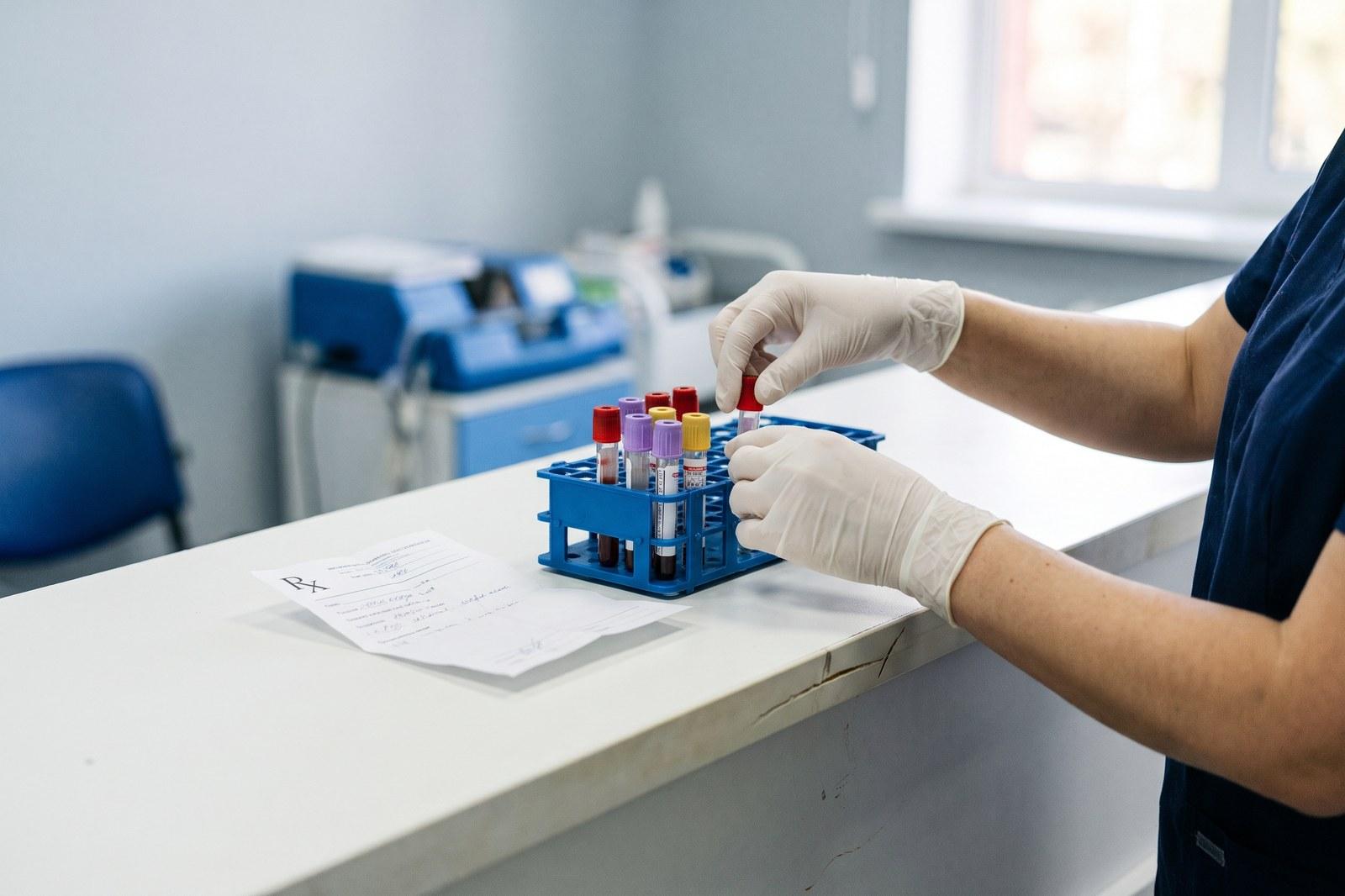
Each test has a fee set by the national nomenclatore, the price list the Italian National Health Service (SSN) uses to pay facilities. Anyone who is not exempt pays the sum of the fees for the tests written on the prescription, blood draw included, up to the regional cap: anything above the cap is covered by the public service.
A prescription for laboratory tests can list up to 8 services from the same branch. If the doctor prescribes more, more prescriptions are needed, and each one has its own cap.
How much individual tests cost
According to data gathered by Altroconsumo, with the nomenclatore in force from 21 September 2026 a venous blood draw costs 4.30 euro. The fees for the most common tests are unchanged from the previous price list.
| Test | Fee |
|---|---|
| Venous blood draw | €4.30 |
| Full blood count | €3.15 |
| Blood glucose | €1.00 |
| Glycated haemoglobin | €4.70 |
| Total cholesterol | €1.20 |
| HDL cholesterol | €1.80 |
| Triglycerides | €1.10 |
| Creatinine | €1.10 |
| TSH | €4.75 |
| Complete urinalysis | €2.55 |
A check with full blood count, blood glucose, total and HDL cholesterol, triglycerides, creatinine and the blood draw therefore comes to about 14 euro. Adding TSH and glycated haemoglobin brings it to about 23 euro, still below the cap.
The cap varies from region to region
The 36.15 euro limit applies in most regions, but not everywhere. According to Altroconsumo, in Tuscany the cap is 38 euro, in Calabria 45 euro and in Sardinia 46.15 euro. Some regions also add a fixed charge per prescription or adjust the ticket according to income, so the final bill depends on the region where you have the blood draw.
The national 10 euro superticket per prescription, which for years was added to the ticket, was abolished from 1 September 2020 by the 2020 budget law. For the exact figure, the most reliable source is still the CUP (booking centre) of your ASL (local health authority) or your region’s health portal.
Who does not pay the ticket
The most common income-based exemptions have specific codes, and the thresholds are updated over time. These are the 2026 values reported by Altroconsumo, calculated on the household’s total income in the previous year.
| Code | Who | Household income |
|---|---|---|
| E01 | Children under 6 and people over 65 | below €36,151.98 |
| E02 | Unemployed people registered with the Job Centre (Centro per l’impiego) and their dependants | below €8,263.31 (€11,362.05 with a dependent spouse) |
| E03 | Recipients of the social allowance or social pension and their dependants | no additional threshold |
| E04 | Minimum pension recipients over 60 and their dependants | below €8,263.31 (€11,362.05 with a spouse, plus €516.46 for each dependent child) |
There are also exemptions for chronic or rare diseases, for disability and for pregnancy, which cover the tests linked to the condition. Tests within screening programmes organised by the region are also free.
Whether an exemption is active is shown in the Electronic Health Record (Fascicolo Sanitario Elettronico), which you access with SPID, CIE or CNS, or on the Sistema Tessera Sanitaria portal in the regions that use it. Income-based exemptions renew automatically every year from 1 April, except those obtained through a self-declaration, and anyone who is entitled but does not find it active can self-declare it online or at the ASL counter (Altroconsumo, 2026).
When the ticket is not enough
The ticket covers the tests your doctor prescribes through the National Health Service, and the general practitioner prescribes them when there is a precise clinical indication. This is the principle of prescribing appropriateness: in the absence of symptoms, some tests useful for prevention, such as fasting insulin or apolipoprotein B, rarely end up on a prescription.
For these tests the route is a private laboratory, without a prescription. Keeping the two routes separate helps you spend wisely, because the tests your GP can prescribe remain covered by the ticket, while those that cannot be prescribed through the SSN can be gathered in a single check-up, with a single blood draw.
The qura check-up includes more than 80 blood and urine parameters, chosen to look at metabolism, the heart, the thyroid and inflammation even when there are no symptoms. During the consultation your doctor goes through the results with you and compares them with those you have already had done with your GP.
Sources
- Altroconsumo. Nuove tariffe per visite ed esami: cosa cambia e di quanto aumentano. 2026. altroconsumo.it
- Altroconsumo. Esenzione ticket per reddito 2026: requisiti, reddito considerato e rinnovo online. 2026. altroconsumo.it
- Legge 27 dicembre 2019, n. 160 (legge di bilancio 2020), art. 1, commi 446-447. normattiva.it
- DPR 22 dicembre 1986, n. 917 (Testo unico delle imposte sui redditi), art. 15. normattiva.it
Frequently asked questions
Do you also pay the ticket for the blood draw?
Yes. The venous blood draw has its own fee, currently 4.30 euro, which is added to the tests up to the cap per prescription.
Does anything change with the electronic prescription?
No. The ticket is calculated in the same way: only the format changes, from the red paper form to the electronic code.
Is the ticket tax-deductible?
Yes. Under article 15 of the Testo unico delle imposte sui redditi (the Italian consolidated income tax law), the ticket counts as a medical expense deductible at 19%, for the portion above 129.11 euro a year.
Tags
- blood test cost italy
- nhs co-payment
- ticket exemption