Home blood draws: how they work, who does them and how much they cost
Written by
Redazione Qura
Medically reviewed by
Dott.ssa Margherita Gabba · Internal medicine
Category
Wellbeing
The Qura editorial team curates and fact-checks health content together with the doctors in the Qura network, with the goal of making test results understandable and useful.
A home blood draw is an ordinary blood test taken at home by a nurse, who then takes the samples to the laboratory. With the Italian National Health Service (SSN, Servizio Sanitario Nazionale) it is reserved for people who cannot get out, on request from their family doctor; privately, anyone can ask for one, paying a call-out fee on top of the tests. If you are arranging tests for an elderly parent, the first phone call to make is to their GP.
On this page
A home blood draw is an ordinary blood test taken at home by a nurse, who then takes the samples to the laboratory. With the Italian National Health Service (SSN, Servizio Sanitario Nazionale) it is reserved for people who cannot get out, on request from their family doctor; privately, anyone can ask for one, paying a call-out fee on top of the tests. If you are arranging tests for an elderly parent, the first phone call to make is to their GP.
Who is entitled to a home blood draw with the National Health Service
The public service guarantees it to people who cannot reach a blood collection point. The Tuscany Region, for example, provides it for patients who cannot walk or cannot be transported by ordinary means, and for those with a temporary condition linked to their clinical picture. The rules in other regions follow the same logic, with differences in the details.
People who often fall into this situation include the very elderly or bedridden, those receiving integrated home care, and those recovering from surgery or a fracture that stops them leaving the house.
How to request one
The public route starts with the general practitioner or the paediatrician. In the request the doctor states the home address, the diagnostic question, that is, what they want to find out with the tests, and the reason why the sample must be taken at home.
With the request you contact the local health authority (ASL), which organises the visit. Booking arrangements vary from one ASL to another: in some a phone call to the health district is enough, in others the request goes directly through the doctor. To find out the waiting times in your area, it is worth asking the CUP (the booking centre) or the health district office.
Who takes the sample
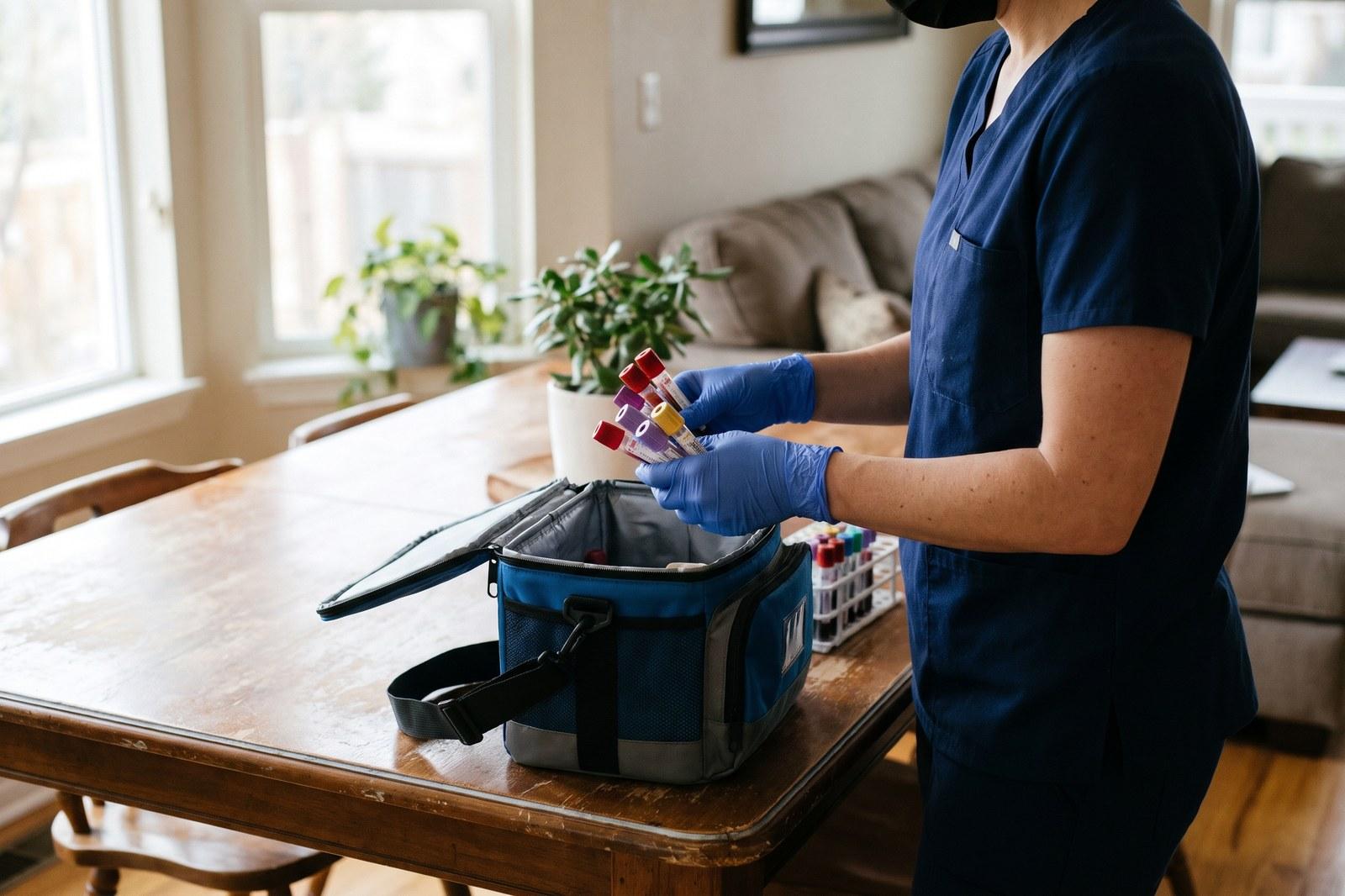
The home venous blood draw is carried out by a nurse, from the ASL or from the private laboratory. As well as blood, they can collect urine, take swabs or collect other samples the doctor has requested.
One aspect matters more than it might seem: the samples must reach the laboratory within precise time limits and at the right temperature, because some values, such as blood glucose or potassium, change if the tube sits for too long. That is why a home service always relies on a laboratory organised for transport, and usually takes place early in the morning.
How much it costs
With the National Health Service, you pay the ticket (the patient co-payment) set by the region for the tests, unless you are exempt. Many people entitled to a home blood draw also have an exemption for age, income, disability or illness, and in that case the tests are free.
Privately, a fee for the nurse’s call-out is added to the price of the tests. There is no single rate: it varies from laboratory to laboratory, sometimes according to distance or the number of people to be sampled in the same household. Before booking, ask for a quote that separates the cost of the service from that of the tests, so you can compare offers fairly.
To give an order of magnitude: on CUP24, which compares private facilities in 19 cities, in November 2026 the call-out for a home blood draw cost between 18 and 32 euro in Rome and between 30 and 70 euro in Milan, tests excluded (CUP24, 2026).
The costs of the blood draw and of the tests are medical expenses: under article 15 of the Testo unico delle imposte sui redditi (the Italian consolidated income tax law), they are deductible at 19% for the portion above the 129.11 euro threshold, with a traceable payment when the facility is private.
How to prepare
The preparation is the same as for a blood draw at the laboratory. Many tests require 8-12 hours of fasting, with water only, and the sample is taken in the morning.
Before the nurse arrives, have ready:
- the prescription or the doctor’s request, if the blood draw is through the National Health Service;
- an identity document and the health insurance card (tessera sanitaria);
- the sterile container with the first morning urine, if a urine test is requested;
- the list of medicines the person takes, because some can affect the results;
- a surface to work on next to a chair or the bed, with good light.
For people who take medicines every morning, such as anticoagulants or thyroid medication, it is worth asking the doctor whether to take them before or after the blood draw: some tests need to be done before the dose.
When it makes sense to choose a home draw
For people who cannot get about, a blood draw at home is the obvious solution. It also makes sense for those who need to repeat the same tests often, for example to monitor anticoagulant therapy, because it avoids tiring trips and waiting.
For those who can reach a blood collection point, however, going to the laboratory is usually still the simplest and cheapest choice, and it lets you do all the tests in one place.
Blood tests and prevention
A blood draw, at home or at the laboratory, is only as useful as what it measures. People who organise one for a parent often focus on the logistics, while the more useful question is a different one: which values are really needed to follow their health over time.
The qura check-up is done at a partner clinic, with more than 80 blood and urine parameters collected in a single draw. If you do not have a clinic nearby or already have recent tests, the Base plan starts from those. Either way, your doctor goes through the results with you during the consultation and tells you which tests to repeat, and when, to follow your values over time.
Sources
- CUP24. Prelievo ematico a domicilio: prezzi nelle strutture private, accessed November 2026. cup24.it
- DPR 22 dicembre 1986, n. 917 (Testo unico delle imposte sui redditi), art. 15. normattiva.it
- Regione Toscana. Il prelievo domiciliare. regione.toscana.it
Frequently asked questions
Is a home blood draw as safe as one at the laboratory?
Yes, when it is done by healthcare staff and the samples reach the laboratory in time. The tubes and procedures are the same.
Can all tests be done at home?
Most blood and urine tests, yes. Some tests, such as the glucose tolerance curve, require several samples at different times and supervision, and are usually done at a facility.
How long do the results take?
The same time as a draw on site: a few days for the most common tests. The report is collected or downloaded online, depending on the laboratory’s arrangements.
Tags
- home blood test
- blood draw at home
- elderly care