Insulin resistance diet: principles and foods to limit
Written by
Redazione Qura
Medically reviewed by
Dott.ssa Margherita Gabba · Internal medicine
Category
Wellbeing
The Qura editorial team curates and fact-checks health content together with the doctors in the Qura network, with the goal of making test results understandable and useful.
There is no single diet for insulin resistance: what works are eating patterns that keep blood sugar stable, such as the Mediterranean one, rich in fibre, vegetables, pulses and whole grains, with little simple sugar and little refined flour. If you carry excess weight, losing some of it improves the response to insulin more than any single food. The starting point is knowing how marked your insulin resistance is, and for that you need tests.
On this page
There is no single diet for insulin resistance: what works are eating patterns that keep blood sugar stable, such as the Mediterranean one, rich in fibre, vegetables, pulses and whole grains, with little simple sugar and little refined flour. If you carry excess weight, losing some of it improves the response to insulin more than any single food. The starting point is knowing how marked your insulin resistance is, and for that you need tests.
Why diet matters
When cells respond less to insulin, the pancreas compensates by producing more of it. Every meal rich in sugars that enter the blood quickly asks the pancreas for extra effort, and over time blood sugar may start to rise.
Diet works on two fronts: it reduces blood sugar spikes after meals and, if it helps you lose weight, especially around the abdomen, it improves the cells’ sensitivity to insulin. In the Diabetes Prevention Program, people with prediabetes who lost about 7% of their weight and did 150 minutes of physical activity a week reduced their risk of developing diabetes by 58% over about three years (Knowler et al., 2002).
The Mediterranean pattern
Among the eating patterns studied, the Mediterranean one has some of the strongest evidence. In the Spanish PREDIMED study, adults at high cardiovascular risk who followed a Mediterranean diet supplemented with extra virgin olive oil or nuts had about 30% fewer new cases of diabetes than those on a low-fat control diet, without any calorie restriction (Salas-Salvadó et al., 2014).
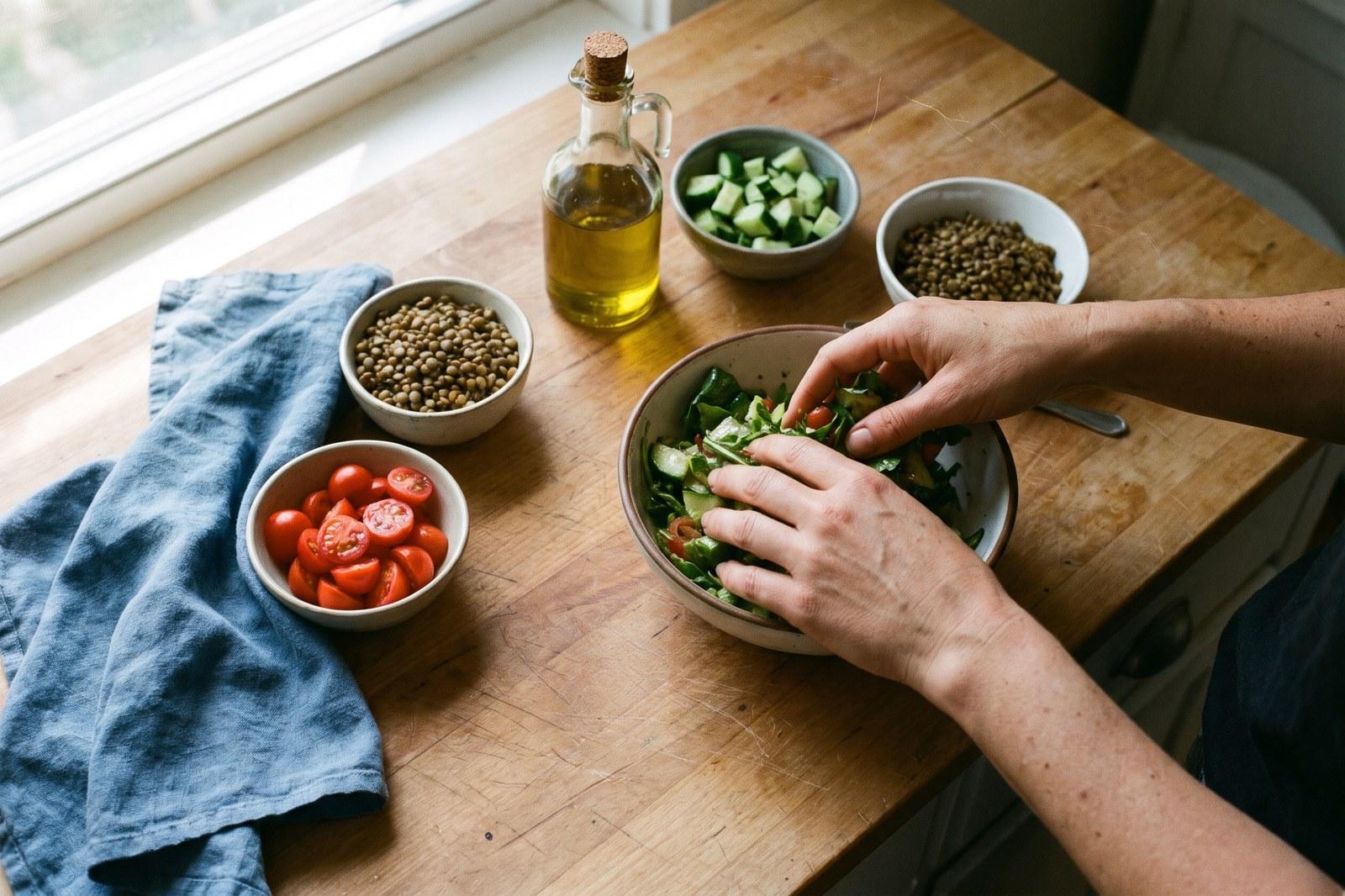
In practice, this means building meals around vegetables, pulses, whole grains, fish, nuts and extra virgin olive oil, with fresh fruit every day and red meat and cured meats only now and then.
Fibre, every day
Fibre slows the absorption of sugars and makes the rise in blood sugar after a meal more gradual. In a large review published in The Lancet, people who ate between 25 and 29 grams of fibre a day had a lower risk of several diseases, including type 2 diabetes, than those who ate less (Reynolds et al., 2019).
You reach these amounts with a dish of pulses several times a week, wholemeal bread and pasta instead of refined ones, vegetables at every meal and whole fruit instead of juice.
What to limit
Sugary drinks are the first thing to cut down. In a meta-analysis published in the BMJ, each daily serving of sugary drinks was associated with an 18% higher risk of type 2 diabetes, and 13% higher even after accounting for weight (Imamura et al., 2015). The same applies, to a lesser extent, to fruit juices, which bring sugars without the fibre of whole fruit.
Next come refined flours and the products that contain them: white bread, crackers, industrial baked goods, sugary breakfast cereals. Together with sweets, they raise blood sugar quickly and are not very filling, so it is easier to eat more of them.
Pasta and rice do not need to be cut out. What counts is the amount, choosing wholegrain versions and what you pair them with: a plate of pasta with pulses or vegetables and a drizzle of oil raises blood sugar more slowly than the same plate dressed only with tomato.
What to choose and what to limit
| Choose | Limit |
|---|---|
| Vegetables at every meal | Sugary drinks and fruit juices |
| Pulses several times a week | Sweets and industrial baked goods |
| Wholegrain bread, pasta and rice, spelt, barley, oats | White bread, crackers, sugary breakfast cereals |
| Fish, eggs, white meat, plain natural yoghurt | Red meat and cured meats often |
| Whole fruit and nuts | Alcohol |
| Extra virgin olive oil | Butter- and cream-based dressings |
Meal order and timing
Some tricks help without changing what you eat. Starting the meal with vegetables, and eating carbohydrates together with protein and healthy fats, makes the blood sugar response more gradual. Meals at regular times help avoid the strong hunger that leads to the most sugary snacks.
Drastic or very unbalanced diets fall outside this picture: they can bring weight down quickly, but they are hard to maintain, and insulin resistance improves with habits that last over time.
Beyond the plate
Diet works best together with movement. Even a short walk after meals helps the muscles use glucose, and regular physical activity improves insulin sensitivity regardless of weight. Sleep matters more than people think: in a study of healthy young people, six nights of sleep cut to four hours worsened glucose tolerance (Spiegel et al., 1999).
Among supplements, the most searched for is inositol. The strongest evidence concerns women with polycystic ovary syndrome: in a meta-analysis of nine studies, myo-inositol reduced fasting insulin and the HOMA index (Unfer et al., 2017). Outside this context the data are scarcer. Like any supplement, it should be taken only on a doctor’s advice after tests: it is not harmless by definition, and supplementing does not automatically mean improving your health.
Start with the tests
An insulin resistance diet makes sense when you know where you are starting from. Fasting blood sugar and insulin, with the HOMA index calculation, glycated haemoglobin, triglycerides and HDL cholesterol show how much strain your metabolism is under, and repeating them after a few months shows whether your choices at the table are working.
Insulin is rarely part of routine blood tests, but it can change years before blood sugar moves out of the reference range. This is why it is always included in the qura check-up, and during the consultation your doctor interprets it with you and builds a protocol that takes into account your habits, your tastes and your lifestyle.
Insulin resistance often gives no signs for years. The ones to know, from waist circumference to tiredness after meals, are in the article on what insulin resistance is.
Sources
- Imamura F, O’Connor L, Ye Z, et al. Consumption of sugar sweetened beverages, artificially sweetened beverages, and fruit juice and incidence of type 2 diabetes. BMJ. 2015;351:h3576. doi:10.1136/bmj.h3576
- Knowler WC, Barrett-Connor E, Fowler SE, et al. Reduction in the incidence of type 2 diabetes with lifestyle intervention or metformin. N Engl J Med. 2002;346(6):393-403. doi:10.1056/NEJMoa012512
- Reynolds A, Mann J, Cummings J, et al. Carbohydrate quality and human health: a series of systematic reviews and meta-analyses. Lancet. 2019;393(10170):434-445. doi:10.1016/S0140-6736(18)31809-9
- Salas-Salvadó J, Bulló M, Estruch R, et al. Prevention of diabetes with Mediterranean diets: a subgroup analysis of a randomized trial. Ann Intern Med. 2014;160(1):1-10. doi:10.7326/M13-1725
- Spiegel K, Leproult R, Van Cauter E. Impact of sleep debt on metabolic and endocrine function. Lancet. 1999;354(9188):1435-1439. doi:10.1016/S0140-6736(99)01376-8
- Unfer V, Facchinetti F, Orrù B, Giordani B, Nestler J. Myo-inositol effects in women with PCOS: a meta-analysis of randomized controlled trials. Endocr Connect. 2017;6(8):647-658. doi:10.1530/EC-17-0243
Frequently asked questions
Can I eat fruit?
Yes, whole and in the right amounts. The fibre in the fruit slows the absorption of sugars, unlike juices.
Do I need to cut out carbohydrates?
Usually not. Quality is what counts: whole grains and pulses instead of refined flour and sugars.
How long does it take to see an improvement?
It depends on where you start. Your doctor usually rechecks blood sugar and insulin after a few months of consistent changes.
Can you lose weight with insulin resistance?
Yes. Losing weight, especially around the abdomen, is one of the levers that most improves the response to insulin, and the process works best when it combines diet, movement and sleep.
Tags
- insulin resistance diet
- mediterranean diet
- blood sugar